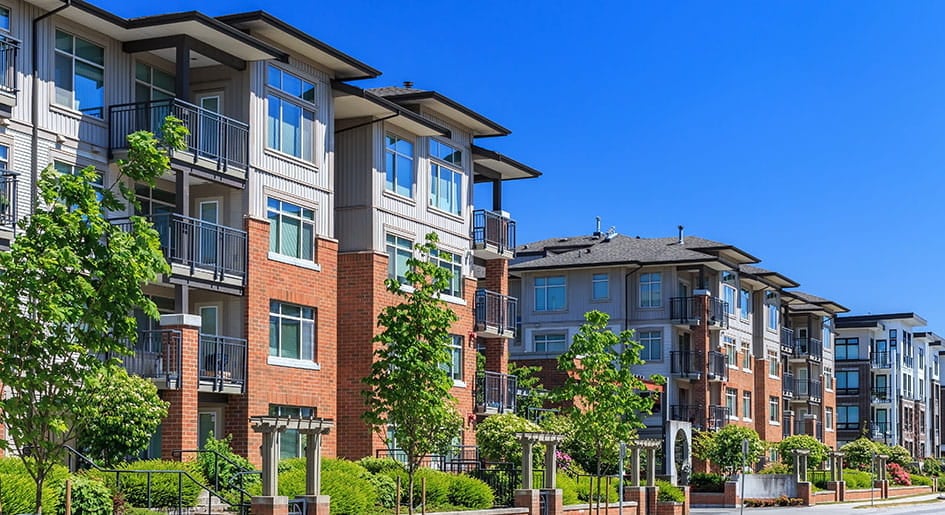
The U.S. multifamily market entered midyear 2026 on more stable footing, with improving demand, a shrinking construction pipeline, and continued investor interest — though risks remain on the horizon.
Demand Is Rebounding
After a sluggish end to 2025, apartment demand bounced back strongly in early 2026. First-quarter net absorption came in roughly 50 percent above the past-decade average, and early second-quarter data suggests leasing momentum is continuing. A healthier job market is helping, with monthly job gains averaging around 100,000 through the first five months of the year — a significant improvement from roughly 10,000 in 2025.
That said, risks haven't disappeared. The oil shock tied to the Iran conflict could dampen consumer spending and business confidence if energy costs stay elevated. A second-half demand slowdown remains possible, but a sharply thinner construction pipeline should help cushion the blow. Completions are expected to fall about 34 percent year-over-year in 2026, hitting their lowest level since 2014.
Why Renters Aren't Buying Homes Anytime Soon
A powerful set of structural forces continues to keep households in the rental market. The monthly cost gap between renting and owning has stayed above $1,000 — compared to a pre-pandemic norm of about $300 — making homeownership out of reach for many. As a result, higher-income households earning over $75,000 per year have become the fastest-growing renter cohort since 2019, driving strong demand for Class A and B properties.
Delayed family formation, rising marriage and childbearing costs, and the weight of student loan debt are also keeping younger households renting longer. With student loan balances near $1.7 trillion and 2.6 million borrowers defaulting in early 2026, many college-educated renters are simply not in a position to buy.
Sun Belt vs. Non-Sun Belt: A Tale of Two Markets
The biggest regional story remains the divide between Sun Belt and non-Sun Belt markets. Sun Belt vacancy sat at 6.3 percent in March 2026, with nearly 50 percent of Class C units offering concessions as new supply continued to weigh on performance. The good news is that deliveries across Sun Belt metros are set to fall 34 percent this year, which should help stabilize conditions — and falling rent-to-income ratios are rebuilding the region's affordability advantage for future household formation.
Non-Sun Belt markets, by contrast, are running much tighter. Vacancy held at just 4.1 percent in March, with stronger rent growth and far fewer concessions. Constrained supply continues to support performance across all property classes in these markets.
Investment Activity and Capital Markets
Multifamily investment sales were up roughly 20 percent year-over-year entering 2026, though trading has moderated somewhat since the Iran conflict began. High-quality stabilized assets in strong locations remain the most sought-after, and Class B properties have been particularly active — posting a 33 percent increase in trades over the past year as investors seek a lower basis with manageable risk.
Cap rates held steady at 6.2 percent nationally in the first quarter, providing more pricing clarity for underwriting. On the lending side, debt availability has improved, with private credit playing a growing role for transitional assets and higher-leverage deals. Senior multifamily spreads have stayed narrow, with stabilized lower-leverage assets pricing around 140 to 150 basis points over Treasurys.
Delaware statutory trusts (DSTs) are also gaining traction, with fundraising up 34 percent year-over-year to $2.4 billion in Q1 2026, as investors seek passive exposure and 1031 exchange-eligible structures.
The Bottom Line
The multifamily market is navigating a complex environment, but the fundamentals remain relatively sound. Falling construction, durable rental demand, and stabilizing pricing all point to a market that is rebalancing rather than deteriorating. Investors who stay selective, focus on quality assets, and maintain disciplined underwriting are likely to find opportunities — even with geopolitical and economic uncertainty still in the mix.