Hiring beat expectations, but the gains were narrow
August's employment report showed a gain of 162,000 roles, well above forecast, while the prior two months were revised up by a combined 55,000 jobs. The rebound extends an unusually volatile stretch, with the dispersion of monthly job gains through August roughly twice that of the same period in 2025, so there is reason to be cautious about reading too much into one month. Hiring also remained concentrated. Food services, local government, and health care accounted for roughly 80 percent of August's net gain. Even so, as long as employment holds near current levels rather than contracting, commercial real estate fundamentals should remain relatively resilient.
San Francisco is rotating, not weakening
Bureau of Labor Statistics data for the San Francisco metro through July 2026 put total nonfarm employment near 2.42 million with unemployment at 3.8 percent, below the national rate. The sector mix runs against the national story. Information employment fell by 4,400 jobs year over year, financial activities by 4,800, and professional and business services by 5,100, while education and health services added 12,800 jobs and leisure and hospitality added 9,000. The Bay Area is losing the jobs that fill Class A units and adding the jobs that fill Class B and Class C units. For owners of older stock, that rotation is constructive.
Thin supply is why Bay Area rents keep climbing anyway
Roughly 1,400 units are scheduled to deliver in San Francisco this year, the smallest pipeline since 2012. With almost no new product coming online, a rotating employment base does not soften rents, it simply changes who is renting. Marcus & Millichap projects San Francisco rent growth near 5.2 percent for 2026, average effective rents around $3,270, and metro vacancy tightening toward 3.5 percent. That combination is why local pricing has held through a white collar job contraction.
Factory hiring is picking up, and not here
The manufacturing build out may be gaining momentum, as the sector added 16,000 jobs in August, a third straight monthly gain. After construction of manufacturing space peaked near 115 million square feet in 2024, more projects are coming online, with second quarter net absorption the strongest since 2022. Manufacturing job openings also rose by 79,000 in July, the largest gain among major sectors. Labor availability remains a headwind, as many manufacturers still report difficulty finding skilled workers. San Francisco metro manufacturing employment went the other direction, down 5,300 jobs year over year, so for Bay Area owners this rebound is background noise rather than demand.
Lower immigration will hit absorption before it hits vacancy
The labor force rose by 683,000 in August and participation edged up to 61.6 percent, indicating improved labor supply. Aging demographics and slower immigration remain longer term constraints. A recent Harvard study suggests the housing impact of fewer foreign arrivals may emerge with a lag, since immigrants typically form households one to two years after entry. The 2025 immigration pullback was estimated to reduce household growth by only about 75,000 that year, but the shortfall could approach 500,000 households annually by 2027 relative to 2024. For multifamily investors the effect may surface as slower absorption rather than immediate vacancy pressure, placing greater emphasis on durable in place income and adding risk to aggressive lease up strategies.
Wage gains at the bottom are supporting renewals
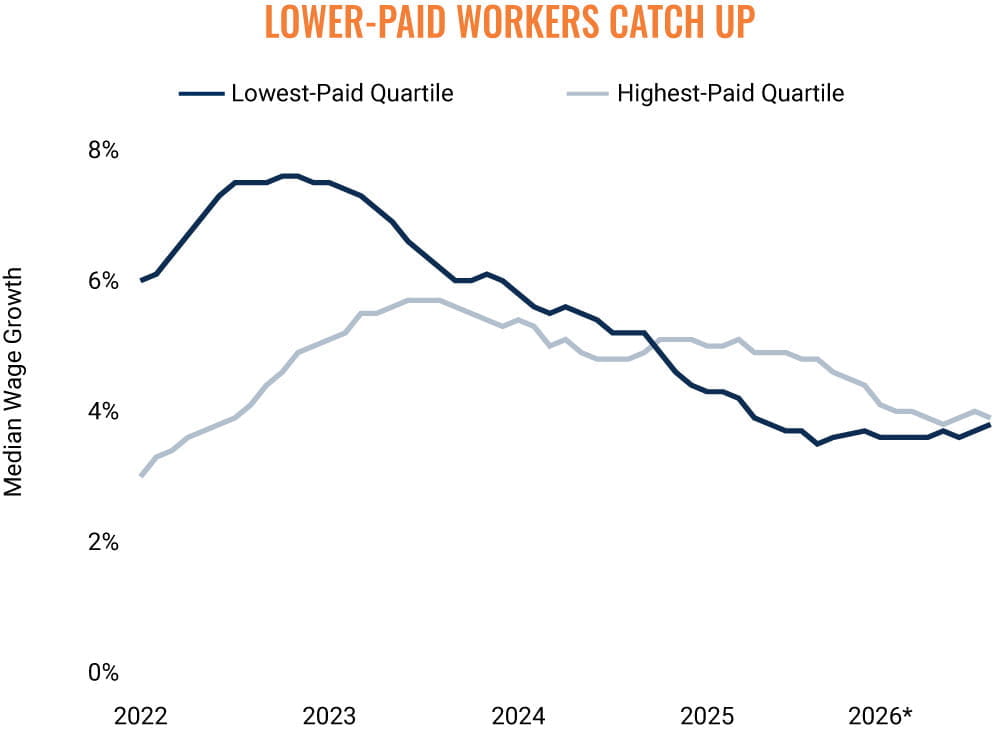
Slower immigration could reinforce wage pressure among lower paid workers, since foreign born workers are overrepresented in traditionally lower paying occupations. Atlanta Fed data show that wage growth among the lowest paid workers has largely closed the gap with the highest paid quartile. Bank of America reports that lower income households now have the strongest wage gains of any income group. This may be helping Class C apartments, where rent growth at renewal remained near 3 percent in July and renewal conversion reached roughly 60 percent, its highest level since 2022. In San Francisco that matters more than usual, because the local job gains are concentrated in exactly the sectors that house Class B and Class C renters.
What Bay Area apartment owners should do with this
If you are holding, push renewals. Renewal conversion near 60 percent and Class C renewal growth near 3 percent say your existing tenants have room and your turnover cost is avoidable. If you are buying, weight durable in place income over projected lease up, because the absorption math gets harder around 2027. If you are selling, the window is specific and favorable. San Francisco cap rates reached 5.2 percent over the year ended March, the highest since 2011, and transaction volume rose roughly 40 percent in the twelve months ending March 2026, against the thinnest delivery pipeline since 2012.
Key takeaways for Bay Area apartment owners
- August hiring beat expectations at 162,000, but roughly 80 percent of the gain came from three sectors, so the trend is less convincing than the headline suggests.
- San Francisco is losing information, finance, and professional services jobs while adding education, health, and hospitality jobs, a shift that favors Class B and Class C rent rolls over Class A.
- Only about 1,400 units deliver in San Francisco this year, the smallest pipeline since 2012, which is why local rents keep rising through a white collar job contraction.
- As more manufacturing facilities come online nationally, hiring is picking up, but San Francisco metro manufacturing employment fell 5,300 jobs year over year, so the rebound does not reach Bay Area rent rolls.
- Fewer immigrant arrivals will slow household formation with a one to two year lag, pressuring apartment absorption around 2027 rather than vacancy today.
- Wage growth among lower paid workers is supporting renewal performance, with Class C renewal rent growth near 3 percent and renewal conversion near 60 percent.
- For sellers, cap rates at 5.2 percent are the highest since 2011 and transaction volume rose roughly 40 percent over the twelve months ending March 2026.
Frequently asked questions
Does the August jobs report change San Francisco apartment values?
Not directly. National payroll prints move interest rate expectations, which move cap rates. The more useful signal for San Francisco valuations is local: a delivery pipeline of roughly 1,400 units and vacancy near 3.5 percent support pricing regardless of what the national number does in any single month.
Which San Francisco apartment class is best positioned right now?
Class B and Class C. Local job gains are concentrated in education, health services, and hospitality, which is that tenant base, and national data show Class C renewal rent growth near 3 percent with renewal conversion at its highest level since 2022. Class A competes for a tech renter pool that shrank by roughly 14,000 jobs across information, finance, and professional services over the past year.
Should Bay Area owners worry about immigration policy hurting the rent roll?
Not in the next twelve months. The effect arrives as slower household formation starting around 2027 and shows up as slower absorption rather than sudden vacancy. It matters most if you are underwriting a lease up or a heavy repositioning with 2027 or 2028 stabilization dates.
Is now a good time to sell a Bay Area apartment building?
Conditions are the most favorable in over a decade on two measures. Cap rates reached 5.2 percent over the year ended March, the highest since 2011, and transaction volume rose roughly 40 percent in the twelve months ending March 2026. Whether it is right for you depends on your basis, your debt maturity, and your tax position.
643,000 | 107,000 |
Jobs Added Year to Date Through August | Average Monthly Job Gain, Past Six Months |
* Through July
Sources: Marcus & Millichap Research Services; Atlanta Fed Wage Growth Tracker; Bank of
America Institute; Bureau of Labor Statistics; CoStar Group, Inc.; Harvard JCHS; RealPage, IncSan Francisco is rotating, not weakening. Bureau of Labor Statistics data for the San Francisco metro through July 2026 put total nonfarm employment near 2.42 million with unemployment at 3.8 percent, below the national rate. The sector mix runs against the national story. Information employment fell by 4,400 jobs year over year, financial activities by 4,800, and professional and business services by 5,100, while education and health services added 12,800 jobs and leisure and hospitality added 9,000. The Bay Area is losing the jobs that fill Class A units and adding the jobs that fill Class B and Class C units. For owners of older stock, that rotation is constructive, and it lines up with the national renewal data above.
Thin supply is why local rents keep climbing anyway. Roughly 1,400 units are scheduled to deliver in San Francisco this year, the smallest pipeline since 2012. With almost no new product coming online, a rotating employment base does not soften rents, it simply changes who is renting. Marcus & Millichap projects San Francisco rent growth near 5.2 percent for 2026, average effective rents around $3,270, and metro vacancy tightening toward 3.5 percent.
What this means for Bay Area owners. If you are holding, push renewals, because renewal conversion near 60 percent and Class C renewal growth near 3 percent say your existing tenants have room and your turnover cost is avoidable. If you are buying, weight durable in place income over projected lease up, since the absorption math gets harder around 2027. If you are selling, the window is specific and favorable: cap rates reached 5.2 percent over the year ended March, the highest since 2011, and transaction volume rose roughly 40 percent in the twelve months ending March 2026.
Let us talk about your building
I have spent 18 years selling apartment buildings throughout the San Francisco Bay Area. If you want to know what the current labor and supply picture means for your specific property rather than for the market in general, reach out.
Philip Batlin
Managing Director Investments, Marcus & Millichap
750 Battery Street, Fifth Floor, San Francisco, CA 94111
Office (415) 625-2189 | Cell (415) 254-7071
[email protected]
CA DRE Lic. 01873218
Let us talk about your building
I have spent 18 years selling apartment buildings throughout the San Francisco Bay Area. If you want to know what the current labor and supply picture means for your specific property rather than for the market in general, reach out.
Philip Batlin
Managing Director Investments, Marcus & Millichap
750 Battery Street, Fifth Floor, San Francisco, CA 94111
Office (415) 625-2189 | Cell (415) 254-7071
[email protected]
CA DRE Lic. 01873218