Story Highlights
- Genentech has submitted plans for its massive South San Francisco campus redevelopment.
- "We're going to be here for the long term," Genentech CEO Ashley Magargee told the Business Times.
- The project will demolish 18 buildings, with construction expected to extend to 2033.
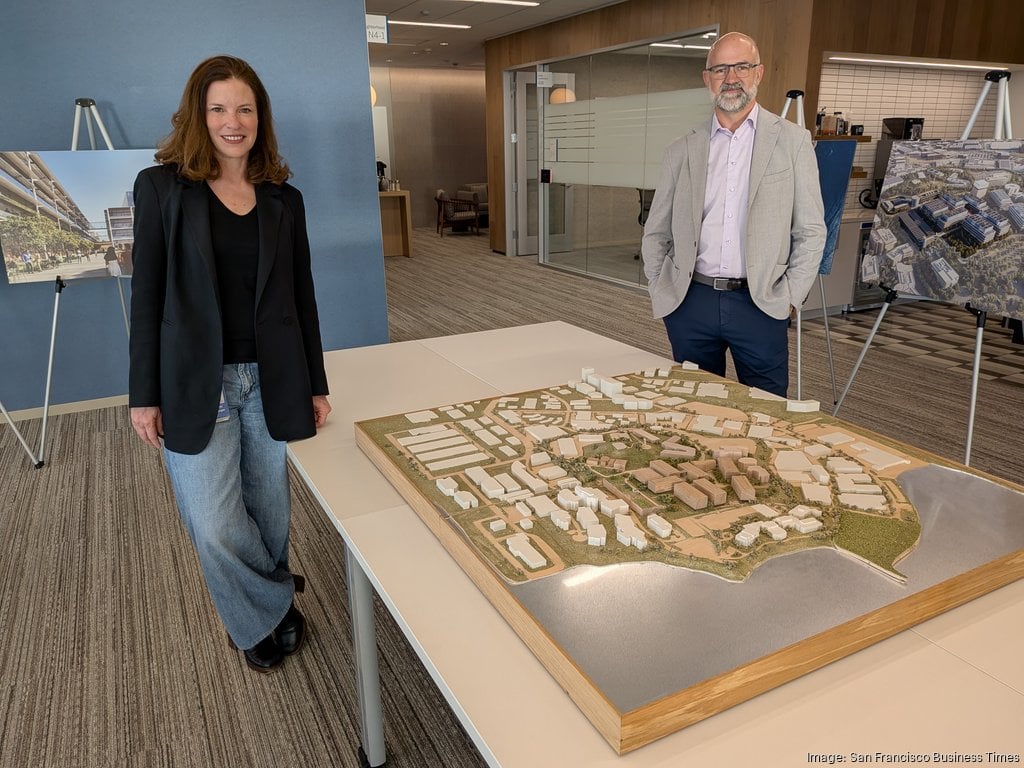
Genentech Inc.'s multibillion-dollar reimagining of its South San Francisco campus will start later this year, unleashing years of demolition and new construction aimed at setting up the pioneering biotech company for its next half-century.
The roots of the project — kicking off as the North American biotech unit of Swiss giant Roche celebrates its 50th anniversary — go beyond the paperwork submitted Monday to South San Francisco city officials. More than three years ago, Roche Chairman Severin Schwan pushed Genentech leaders to envision the technologies needed in the next 50 years, and how those innovations could shape building use.
"We're going to be here for the long term," Genentech CEO Ashley Magargee told the Business Times in an interview. "And when you start to think a little bit more around (that), we keep saying to ourselves, 'What will the next 50 years look like?'"
The project, first reported by the Business Times in July, comes as the maker of cancer, immunology and other drugs reconfigures its business through acquisitions and layoffs, the sale two years ago of its giant Vacaville manufacturing facility and closer ties to its parent company.
Other mature life sciences companies have reassessed their space and technology needs in recent years: Gilead Sciences Inc., for example, is looking to expand beyond its Foster City campus. Bayer AG won Berkeley city approval in 2021 for a plan to demolish decades-old buildings and build anew around cell therapy manufacturing and other new technologies.
Innovations in biology, chemistry and artificial intelligence already have shaped drugmakers' ability to scrub data to discover and develop drugs, Magargee said. Those changes will require more electrical power, for example, an important part of the new Genentech campus.
"We know that we're going to be here, and we know we're going to be innovating and continuing along this trajectory," she said. "And so then you think about the physical space and what do people, our scientists, need."
Genentech's master plan with South San Francisco allows it to build up to 9 million square feet. Genentech officials would not disclose the total cost of the project, but sources have told the Business Times the project will range from $3 billion to $5 billion and create more than 1,500 jobs.
Blank slate
Work on the new campus will begin with demolition later this year and all building work will be completed by 2033, said Fergus O'Shea, senior vice president of real estate and workplace for Genentech. It will include some of the oldest buildings on campus, the Founders Research Center near the bay that has housed Genentech research and early development, or gRED, that is the historic heart of the company's scientific work.
Right now, walking between the Founders Research Center and buildings at the top of the hill means traversing hills and multiple staircases, equivalent to a climb up 13 stories.
"It's not superwalkable," Magargee said. "That's kind of the goal with bringing all of the (research) toward the center of campus and you're taking advantage of the topography here. I mean, the views up here are phenomenal."
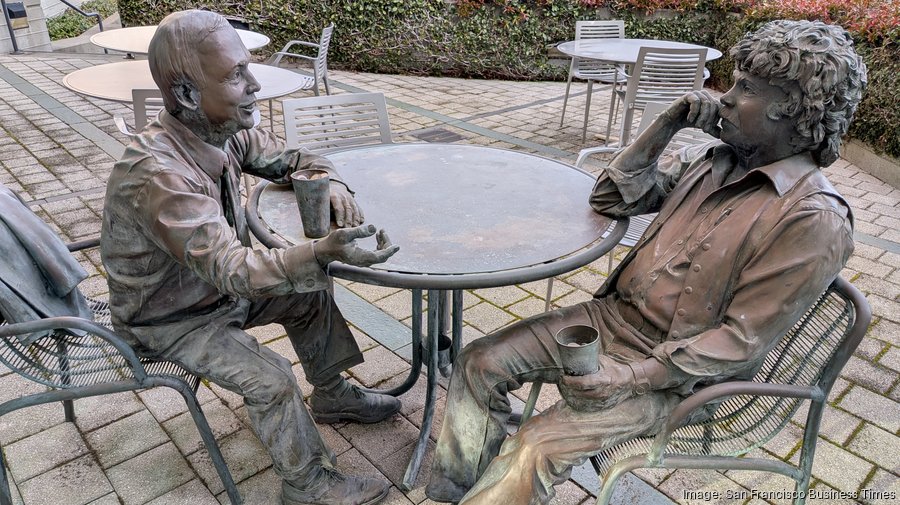
In talking to early Genentech employees, such as the company's first scientist, Dave Goeddel, Magargee heard stories of a growing company in one former warehouse and one lab in South San Francisco.
"They talk about everyone being on top of each other in this warehouse and how exciting it was to be doing all that work," Magargee said. "Then we grew organically and were able to get more and more buildings and convert them or start new space, but we now find ourselves looking at the research and early development space, and those buildings are coming to the end of their life cycle."
Genentech's campus now houses about 8,000 people. The 60 buildings on campus range from 10 years old to more than 40. In all, 18 buildings will be demolished.
"It was Severin Schwan who really challenged the team and said, 'Hey, what if we had a blank slate on the campus?'" Magargee said.
To that end, Genentech has added 18 acres to its now 225-acre master plan, amended and approved by South San Francisco officials last year. That expansion included three islands of property landlocked within the campus, including the Dome Construction site off East Grand Avenue, the former home of the San Francisco Baking Institute on DNA Way and a structure that housed packaging manufacturer Lithotype Co. Inc. on Point San Bruno Boulevard.
Genentech also bought three strips of on-campus streets from the city, including DNA Way, the winding, uphill thoroughfare that cuts through the heart of the campus. The roadway will be severed in the company's plans.
The new look will create clusters, including one uphill for gRED, another around manufacturing and labs and another around development. Each of those will include social hubs with lounges and cafes that encourage unplanned interactions.
"What we've created in the configurations are these clusters of buildings so that gRED is considered the heart in the middle," Magargee said. "The goal is to make sure that those interactions are happening."
A Meta hire
O'Shea was hired by Magargee in early 2025 after leading Bay Area campus development for Facebook parent Meta Platforms Inc. Most recently, O'Shea was Meta's senior director of global design and projects and head of real estate and facilities projects in North America, overseeing the company's expansion from the former Sun Microsystems campus in Menlo Park to a new building designed by Frank Gehry and other adjoining properties.
"I wanted Fergus and his expertise," Magargee said.
The South San Francisco headquarters includes the seven-story, 230,000-square-foot Building 86 — just off Highway 101 on Gateway Boulevard, a mile from the main campus — that is a kind of prototype for what Genentech wants to do going forward. The all-electric structure is leased from Alexandria Real Estate Equities Inc. (NYSE: ARE) into 2034. Employees moved in starting in 2024.
"We're using that to be able to kind of test out different configurations for the lab space," O'Shea said. "And that's kind of the closest thing to what we kind of imagine for gRED."
Genentech is working with Pacific Gas & Electric Co. on the biotech company's plan to build its own on-campus substation, O'Shea said. That would be built in a way that allows it to expand over time, he said.
The plans are guided by Roche standards and design principles, O'Shea said. The parent company, for example, has set a goal to halve its carbon footprint by 2030.
Genentech has been undergoing other changes in recent years, cutting hundreds of jobs including scientist roles, selling its big Vacaville manufacturing plant, eliminating commercial manufacturing and growing clinical manufacturing on-campus.
Building 86 is emblematic of that transition. As employees moved into the structure two years ago, the organization's layoffs bled it of top cancer researchers and other top talent. Some employees have worried that a top-down structure threatens Genentech's legendary innovation culture.
At the same time, Genentech and Roche have committed to $50 billion in U.S. investments in the next five years. That includes a manufacturing project in North Carolina, which Genentech recently doubled to $2 billion and 500 jobs, and the remake of the South San Francisco campus.
The changes are personal for Magargee, who started her Genentech career in Building 24/25 along DNA Way, working in market access for cancer drugs more than two decades ago.